
Seeney’s Sawmill
Back To Sawmills
Home Page
Our People
Seeney’s Sawmill
A Pioneer of Timber and Town
William George Seeney was one of the early timber pioneers in the Woodford and Villeneuve districts. Working as a timber-getter from as early as the 1890s, he played a significant role in Queensland’s timber industry through various ventures, including a sawmill at Villeneuve and earlier projects in Woodford and Caboolture. His timber was even used to pave some of Brisbane’s busiest streets at the turn of the century. Although his Villeneuve mill operated for only a short period, Seeney’s impact on local industry and infrastructure left a lasting mark.

William George Seeney.
Photo courtesy Kay Youngberry.
Timber & Mill Ventures
A Life in Timber: From Woodford to Villeneuve
William George Seeney (1859–1937), often referred to as George, was living at Villeneuve by 1890. He selected Portion 73v in the parish of Byron, a 156-acre homestead property, and worked as a timber-getter. George began his sawmilling career in partnership with his brother-in-law James Green, operating a small mill behind Tom King’s shop in Woodford. He later worked with Alex McCallum at a mill in Caboolture, primarily to cut wood-pavement blocks used in Brisbane city streets.
The Villeneuve Sawmill
Brief But Notable: The 1901 Villeneuve Mill
In 1901, George erected a sawmill on his property in Villeneuve. The mill was operational by July that year, as noted in The Queenslander. However, the venture was short-lived—by the end of 1903, George decided to close the mill and move on. He later ran a sawmill at Hereford Hills (Sheep Station Creek, Kilcoy area) from 1908 to 1911, before leaving the area in 1917.
Timber for Brisbane Streets
Paving the Way: Brisbane’s Wooden Streets
George’s timber found its way into a unique piece of Brisbane history. In 1898, Queen Street was paved with 6-inch square, 12-inch long hardwood blocks—all sourced from within 70 miles of Brisbane and laid on concrete.
A Brisbane company, Chamberlain and Wyllie, began the work using powerful horse-drawn ploughs, but later handed over the contract to George Charles Willcocks when the scale proved too large.
Two plough teams were used each operating 12 powerful horses. Four drivers were required and three men to hold and guide the plough.
Unfortunately, the blocks became dangerously slippery and were eventually replaced with gravel and tram sleepers. Still, the blocks were a notable engineering experiment—and Seeney’s timber was at the heart of it.

Ploughing George Street towards Roma Street, 1890s:
Photo courtesy The Royal Historical Society Queensland.

Queen Street Brisbane paved with blocks of wood.
Photo courtesy of The Royal Historical Society Queensland.

Queensland Times (Ipswich) 6th August 1937
A Life Remembered
In August 1937, William George Seeney passed away at his home in Nerang at the age of 77. His death notice, published in the Queensland Times, reflected a life of enterprise and contribution—spanning education, sawmilling, and later business ventures. His legacy extended beyond the timber industry, leaving a mark on both the communities he served and the industries he helped shape.

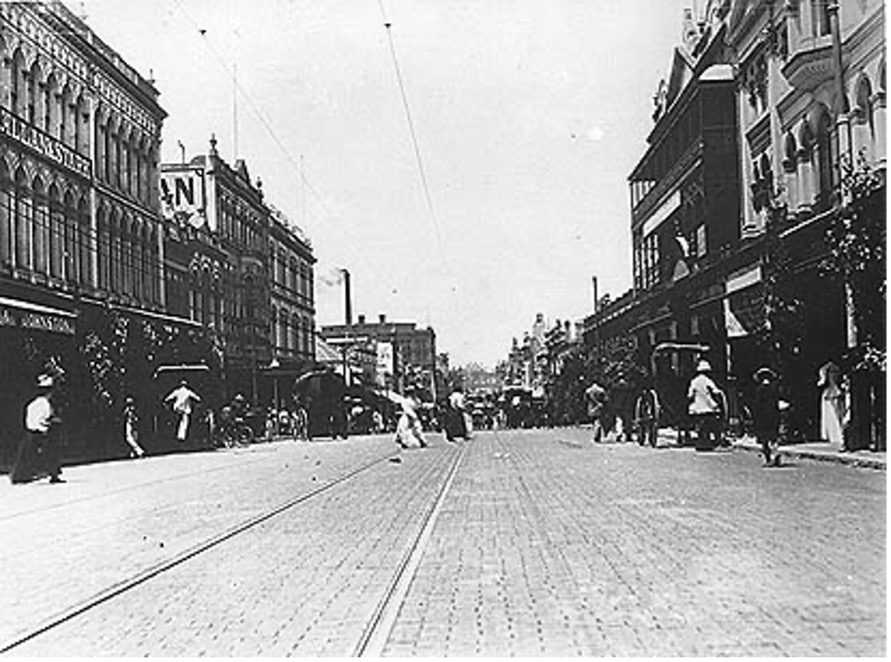
Wooden Blocks laid in Queen Street Brisbane
Seeney in Woodford
George Seeney’s timber story began alongside James Green in a modest four-horsepower mill behind King’s Store.
Their early collaboration in Woodford laid the groundwork for the mills they would later build in Villeneuve. Read more ?
Go Back
Explore The Map
WE ARE Seeking
Your Stories
We’re on the lookout for local memories, photos, and memorabilia that tell the stories of our community.

VISIT
10am to 2pm
Tue | Wed | Fri| Sat
& Every 3rd Sunday
Address
109 Archer Street, Woodford, Queensland, Australia,
Markets
Woodford Country Markets
are held on the 3rd Sunday of
each month from 7am to noon.